Pomodo is Now Bracadia
Pomodo.io is now Bracadia.com. The same writer, the same research, the same free Pomodoro timer, under a new name that reflects where this is heading: a focus method built on the science of how attention actually works.

Jonathan Griffin
Productivity Writer & Developer
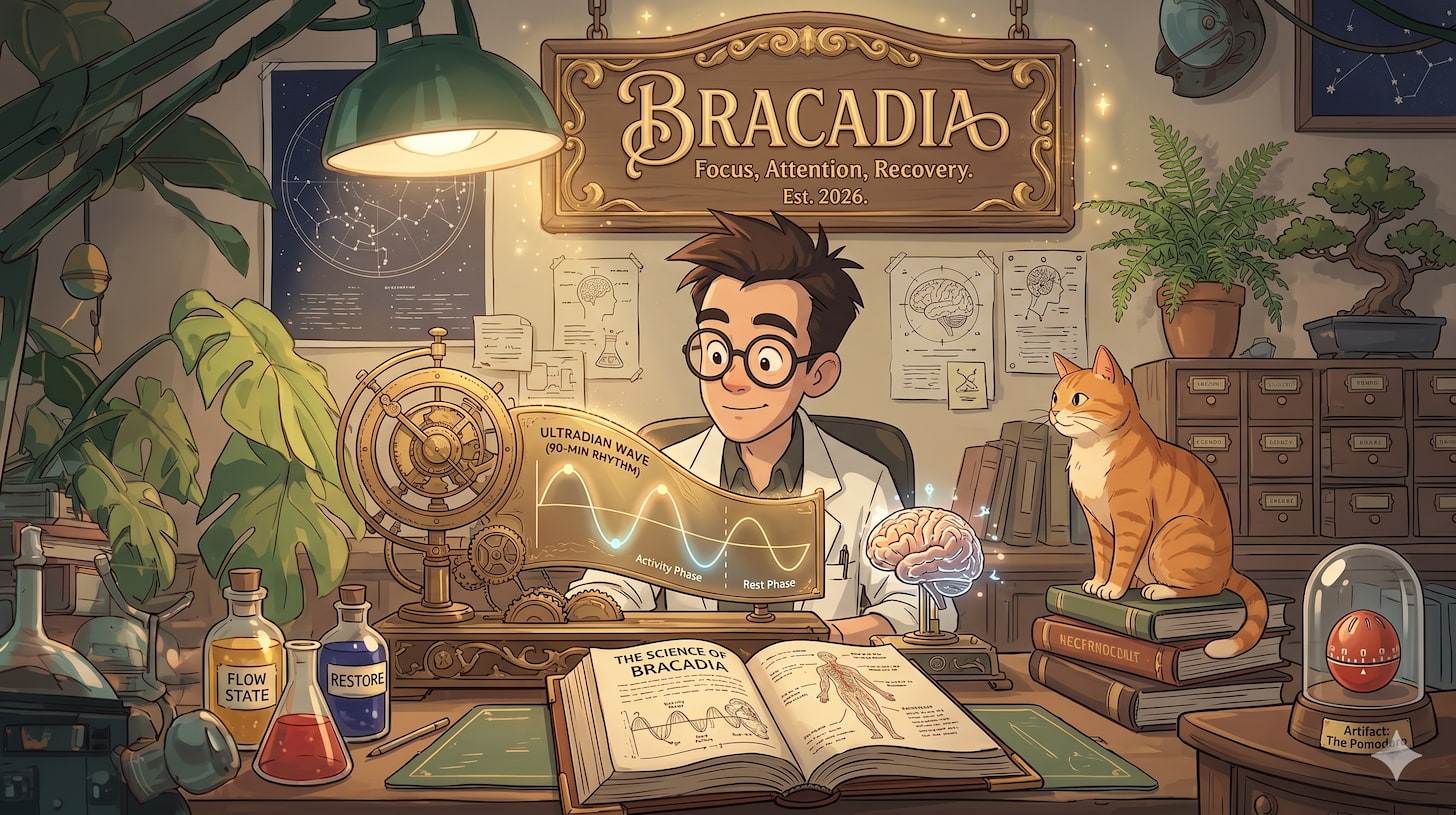
Table of Contents
The rename, the new name, and what it means for you
Why the Name Changed
From a Pomodoro timer to something broader
Why Bracadia?
A name rooted in the body's natural rhythm
Why the Bracadia Method?
The science and the inspirations behind the method
What Is Staying the Same
The timer, the writing, and your links
Where Bracadia Is Heading
The method and app we are building next
Additional Resources
References and trademark notice
Why the Name Changed
From a Pomodoro timer to something broader
When this site started, it was a Pomodoro timer with a blog attached, and the name “Pomodo” said exactly that. But the writing kept pulling in a different direction: into the actual science of focus, attention, and recovery, and into the question of why a fixed 25-minute timer was ever treated as the answer.
The deeper we went into where productivity science comes from, the clearer it became that the Pomodoro technique is one good idea among many, not the destination. The project needed a name that was not tied to a single tomato timer. Bracadia is that name.
Why Bracadia?
A name rooted in the body's natural rhythm
Bracadia is a coined name, and its root is deliberate. It comes from BRAC, the basic rest-activity cycle: the roughly 90-minute rhythm of activity and rest that the sleep scientist Nathaniel Kleitman first identified, and which he proposed continues through our waking hours as recurring swings in alertness[1]. That cycle is the clock your body already runs on, long before any tomato timer was involved.
Naming the brand after the underlying rhythm, rather than after one technique, is the point. “Pomodo” could only ever be a Pomodoro timer. Bracadia has room to grow into the research, the tools, and a focus method that goes well beyond it.
Why the Bracadia Method?
The science and the inspirations behind the method
The method takes its name from the brand, and so from that same BRAC cycle. But the rhythm is only the starting point. The method brings together a few ideas about how focus actually works.
The first is that natural rhythm itself: Kleitman’s ~90-minute cycle, not a fixed clock but something that shifts from person to person and even across a single day[2]. The second is flow, the state of absorbed, effortless focus worth protecting rather than interrupting.
Two further inspirations shape it. Tony Buzan’s work on learning drew on how we recall more from the beginning and end of a session than the middle, so well-placed breaks are not lost time, they multiply the moments where memory sticks[3]. And we want the habit to be engaging, drawing on the ideas behind gamification, a sense of progress and play, rather than the heavy tracking and bookkeeping most people abandon. The full case, with the science, is laid out in Introducing the Bracadia Method .
What Is Staying the Same
The timer, the writing, and your links
- The free Pomodoro timer at /timer/ is still here: still free, still no-signup, and working exactly as before. Run it as a classic Pomodoro timer or to any rhythm that suits you.
- The science writing continues with the same evidence-first approach, now under bracadia.com .
- Your links still work. Pomodo.io, and the older domains before it, redirect here automatically. There is nothing you need to update.
Where Bracadia Is Heading
The method and app we are building next
The Pomodoro technique was one person’s idea, refined with a kitchen timer in the late 1980s and shared as a free PDF. It works for a lot of people. But almost nobody uses its full system of planning, recording, and reviewing; most people only ever use the timer. And the 25-minute interval was never tuned to anyone’s biology.
So our goal is to build the Bracadia Method: a way of working that fits your real rhythm instead of an arbitrary clock, with less friction rather than more. The method, and an app built around it, are in development, and because the work is research-led it will take time to do properly.
Same free Pomodoro timer today, a more flexible and science-led method on the way. That is Bracadia.
References
Sources and citations for this article
- 1.Kleitman, N. (1963). Sleep and Wakefulness. Rev. & enl. ed. University of Chicago Press. (Cited on p. 365)
- 2.Kleitman, N. (1982). Basic Rest-Activity Cycle—22 Years Later. Sleep, 5(4), 311–317. (Cited on p. 314)
- 3.Buzan, T. (1982). Use your head. Ariel. (Cited on p. 54)
Trademark Acknowledgement
Trademark and non-affiliation notice
About the Author
Jonathan Griffin is a productivity writer and developer, and a former UK commercial property solicitor. He works from the primary literature, turning peer-reviewed neuroscience and cognitive science into practical, evidence-based systems for focus and attention, and building the tools that put them into practice.