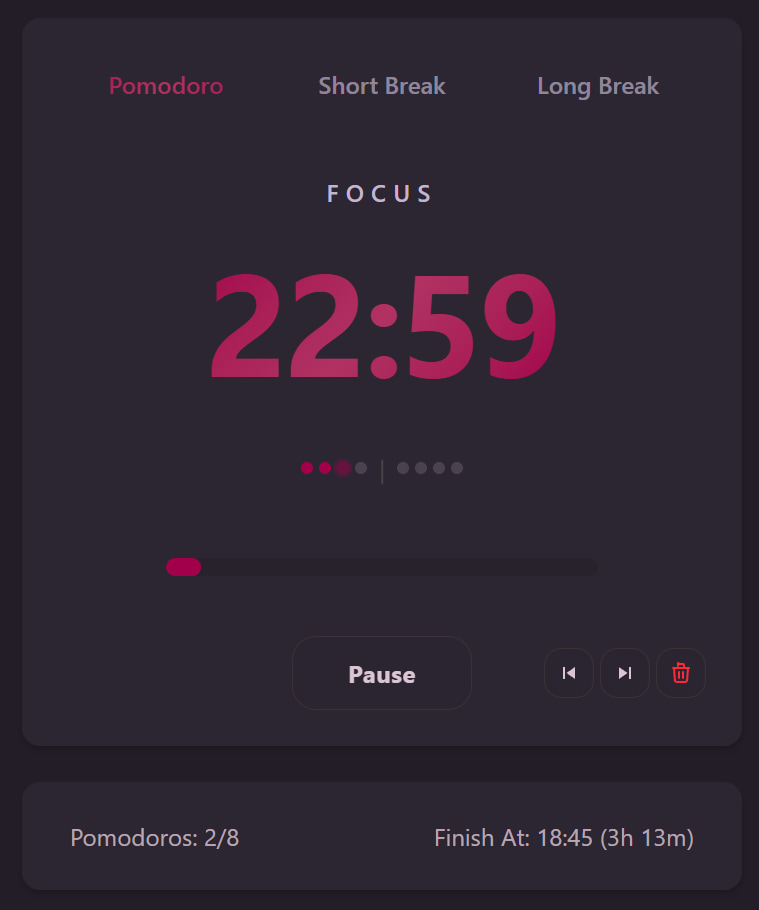
A free Pomodoro timer, ready when you are.
Start a focus session in seconds, no signup. Alongside it, we’re building our own based on the Bracadia Method. It’s a separate timer that flexes to your natural rhythm instead of a fixed clock.
Where do you want to start?
Three ways in. Pick the one that sounds like you, then open the timer.
Studying?
Just focusing?
Deep work?
A Pomodoro timer today, the method we're building
Honest about the now, clear about what's coming.
"Pomodoro" is a trademark of Francesco Cirillo. Bracadia is independent and not affiliated with, associated with, or endorsed by Francesco Cirillo.
How it works
The method we're building rests on one idea: focus moves in cycles, and the timer should bend to yours.
Focus moves in cycles
Your attention naturally rises and falls in cycles of roughly 90 minutes, an applied take on the body’s ultradian rhythm, not in identical fixed blocks stamped out by a clock.
Your rhythm is your own
That cycle is real, but its length shifts from person to person and across the day. There is no single magic number that fits everyone.
So the timer fits you
You set the block to match your own rhythm and the task in front of you. Flexible, not arbitrary, the one idea the whole method rests on.
What is the Bracadia Method?
The short version.
The Bracadia Method is the focus approach we’re building at Bracadia. Instead of forcing every task through one fixed timer, it fits the length and rhythm of each session to what you’re actually doing: short, break-rich blocks for studying, longer protected stretches for deep work, and recovery treated as part of the work rather than time stolen from it.
It pulls together three threads of research, Nathaniel Kleitman’s roughly 90-minute body cycle, Tony Buzan’s work on how breaks shape memory, and the psychology of flow, kept deliberately flexible because your biology isn’t a fixed clock.
Less friction, more focus
Where we're headed, the upgrade is mostly in what disappears.
No hard stop mid-flow
Never get yanked out of deep concentration just because a fixed timer said the slot was over.
No one-size number
Stop forcing your work into someone else’s interval. Your block, your length, your call.
No penalty for pausing
Step away when you need to. Picking the work back up doesn’t cost you a streak or reset your progress.
No bookkeeping
No tallies to keep, no tracking overhead, no admin. Just focus, then recover.
No clock-watching
Set your block and stop staring at the countdown. The timer stays out of your way so your attention stays on the work, not the clock.
No marathon burnout
Real recovery is built into the rhythm, so you can sustain focus across a whole day instead of sprinting until you crash.
Why trust this?
Real research, not a productivity fad.
The learning side is the best-evidenced part of the method. Tony Buzan’s work on study and recall shows that memory peaks at the start and end of a session and dips in the middle, which is exactly why shorter, well-broken blocks help you retain more. The rhythm side draws on decades of research into the body’s natural cycles, from Nathaniel Kleitman’s foundational sleep science onward.
We lay the evidence out in full in the Science Hub , with sources cited chapter by chapter. And all of it is free: no signup, no account, no catch.
Keep exploring
Four ways to go deeper.
- Open the Pomodoro timer — start a focus session right now, free and in your browser.
- The Bracadia Method — what it is, the science behind it, and what we’re building.
- The Science Hub — the full, cited story of focus, fatigue, and the rhythms behind deep work.
- The Blog — practical guides, methods, and walkthroughs, including the classic beginner’s session guide.
Ready to work with your rhythm?
Open the free Pomodoro timer and run your first session, then dive into the Science Hub to see the research behind the Bracadia Method we're building.
Free timer. Free research. No signup, no account.